
Cities are increasingly being built for cars and not for people, when it should be the other way round. And more cars (irrespective of whether they are green or not) mean reduced green cover in the city and increased cover of asphalt, roads and concrete. And that is the challenge of sustainability – how to cause change without affecting change to the other ecosystems. A car is a big ticket item for many. And a green one takes it a few more notches up. Even if the payback period gets justified and the worthy consumer actually rewards a Toyota Prius or a Nissan’s Leaf or a Chevy Volt or a Ford Fusion, that will solve one challenge and create a problem somewhere else – which stands against the whole systems thinking that sustainability calls for.
Urban Mobility v/s Personal Use Car
There are 2 ways to look at the sustainability of the auto industry at large within Indian context: One from the Urban Mobility viewpoint and the other from the respective car manufacturers internal sustainability initiatives. There’re no cars in a sustainable urban mobility viewpoint, while personal use car is the only thing that keeps the car makers in the business.
For making a sustainable Urban Mobility a reality for all, a different set of questions call for an answer:
- How can we reduce the personal use cars?
- How can we reduce the miles driven/trips made?
- How to redefine how people live and work?
- How do we increase the walkability on our roads?
A sustainable city of the future is not what we see in some “futuristic” sci-fi flick. It is the whole redefinition of capitalism at large. Conscious Capitalism Institute is doing just that. Clean Air Initiative (CAI) and Embarq, a WRI body are working towards improving the quality of lives in our cities through sustainable transport solutions.
Lofty goals of Indian Automotive sector
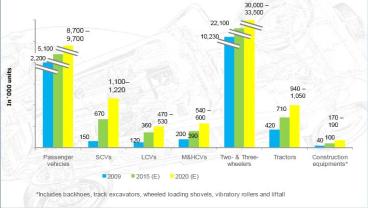
The Society of Indian Automobile Manufacturers (SIAM) mission is to become a growth engine of Indian economy by propelling the Indian Auto Industry to a global $145 billion industry by 2016 whilst promoting sustainability by addressing multiple challenges arising out of emissions, climate change, energy and security.
And when we see the car penetration in India which is barely 30 per 1000 people as compared to 750 per 1000 people in US and other developed world – India has not even started driving yet and the SIAM’s mission may well over exceed its target (whether such growth will actually solve the climate change and energy problems is another issue). Point to note is that the ratio of fuel price per capita income in India is the highest in the world.
Car makers delimma
While a car maker may introduce a number of Pollution Prevention and Resource Recovery strategies within its plant and the supply chain and finally come up with a hybrid or a clean-fuel run car – it will eventually use the premium road space, thus escalating the problem of walkability which is already scant in the Indian cities. So, even if the car industry succeeds in making a carbon-neutral car, it isn’t necessarily one – it is affecting the change in urban and rural landscape.
It is a well know fact that 90% of carbon impacts over the entire life cycle of a car happens at the user stage (becasue of petrol use) and the 10% happens at the manufacturers side. So, when a company says that it is reusing its paint sludge, treating its waste effluents, making its plants landfill-free, recylcing its scrap, removing VOC’s and other hazardous chemicals, reducing its energy (fossil fuels) consumption, greening its data centers/servers (Green IT) and all the other programs of stakeholder and employee engagement – it means that this will only affect the 10% of the carbon impact!
So, when you have a car that runs on battery or some other alternative fuel, those 90% of the impacts at the consumer stage suddenly disappear and the 10% manufacturing impacts suddenly appear very big (which are humungous in absolute terms). So, whatever sustainability initiatives car makers are taking suddenly gain importance and become a fierce competetive edge. And you can say goodbye to a company that does’t yet have some form of Environmentally friendly vehicle in its product mix.
The Car is the problem
Now, let’s see what SIAM has in mind for driving car penetration in India. They have 3 Aternative Fuel Strategies:
- Short term: CNG, LPG, Ethanol
- Medium term: Bio-diesel, hybrid and electric
- Long term: Hydrogen and Fuel cells
This clearly means that car is not going anywhere. The road to the low carbon future very much includes cars. Car was invented more than a century ago and are still in use…come to think of it, the technology of making a car hasn’t evolved much since its invention (you still got the 4 wheels and you still got to build the roads). But there are people who are talking about building our futures without cars, which I personally feel will be a fantastic thing to have in a city that will be for people and not cars.
So, we need to understand that carmakers are in the transportation/mobility business and not in the “green car” or technology business. While the auto industry served its purpose for decades and decades, it’s now time to rethink the whole transportation and personal mobility paradigm. India is at a point where it can keep powering ahead with its economic growth while ignoring the environmental impacts, or it can define a new path, a new path to building more sustainable cities – potential is huge in both directions.
Related reads:
- Green cars at Delhi Auto Expo 2012…So What!
- 3 organizations that are making our cities walkable
- Mobile Tech is driving Zip Car into future (Wall Street Journal)
- Urban Mobility is fast becoming Social, Mobile and Peer-to-Peer
- “Sustainability in Motion” at Tata Motors
- “The Rise” is the new ‘Alternative Thinking’ at Mahindra
- Road tax changes being considered (bbc.co.uk)
- Car Makers Say California Electric Car Industry Running On All Cylinders (sanfrancisco.cbslocal.com)
- Electric car battery makers hit the skids (gigaom.com)
(Images credit: SIAM)



 Linking Sustainability
Leave a reply to jpgreenword Cancel reply