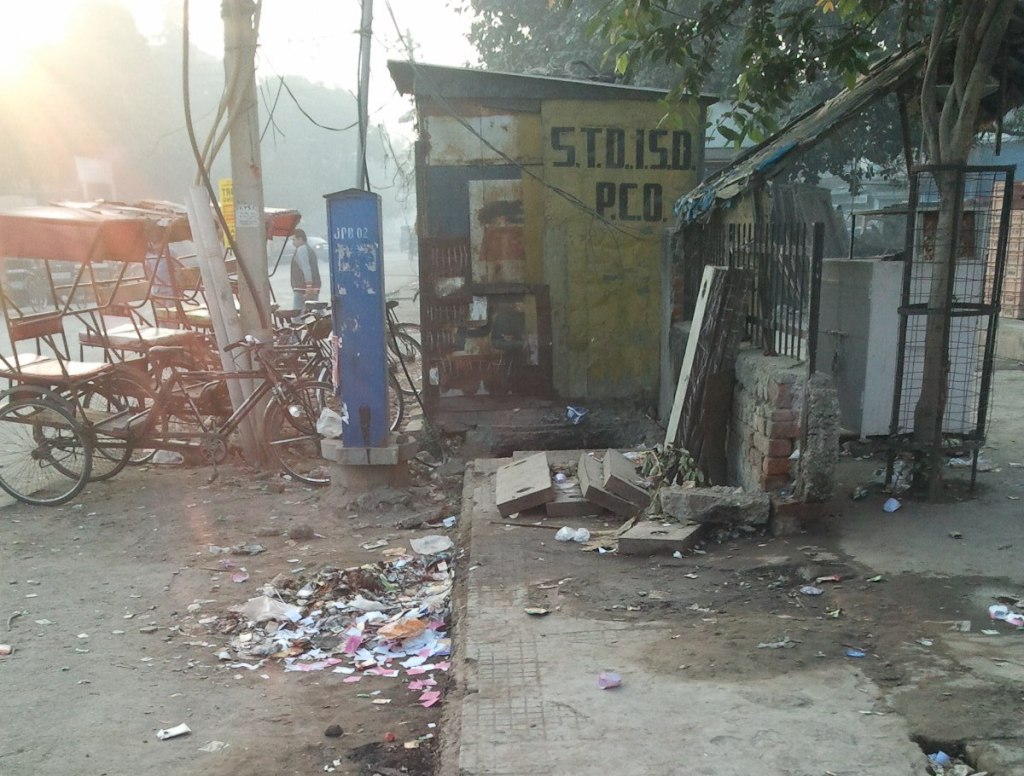
So, we have 2 questions to tackle – Why do we need walkable cities and how do we go about building them? This post tackles the why. My next post will look into the how of it.
So, why do we need more walkable cities in India?
- It helps reduce crime and hence makes more safer cities
- It helps reduce use of motorized transport and hence reduce traffic congestion and pollution
- It helps burn body fat and hence reduces weight and keeps you fit
- It helps see the place from the ground and hence helps make a connection with the smells and sights of the city
- It helps in building strong community relations and hence keep people social – their inherent characteristic

Besides these so very valid points, we need walkable cities in India simply because many developed countries in the world are and if we are to follow them, this feature of walkability needs to be embedded in the basic urban infrastructure of the city.
Cities, essentially have been built for cars and that is why we see thousands of roads criss-crossing the city landscape with very little scope of walking. Sure, distances can be quite daunting and excruciatingly long to cover on legs, but the urban mobility is not all about ownership of vehicles.
Public transport blended with walking is arguably the best mode of transport of any city of any shape and size. Sometimes costs can be prohibitive to provide access to public transport in far flung areas – fine – use cars instead. But at least in the heart of our cities we can build a robust system of transport network that can embed it self so that common folks are not ashamed of using it and doesn’t hurt their egos.

Bicycles…ahem..!
Then there’s an option of using NMT’s or Non-Motorized Transport system like the bicycles to work! It may seem a highly practical choice in many other cities of the world – especially in the European and Japanese cities. But it is a big NO for Indian cities as bicycles are viewed as “poor man’s mode of transport” and is looked down upon by the rich…read motorists.
Pedestrians and cyclists have the greatest number of fatalities and deaths on Indian roads. Statistics speak. Blending these options into the sustainable urban mobility mix is a challenging job in India.
Incentivizing and bringing behavior change
Let’s say, in time of a salary raise, companies, instead of giving a car or extra cash for carbon emitting petrol, gives premium passes to its luxurious coach that transports them in a style befitting them – limosine type.
The pride that comes with ownership is not a natural phenomena – it is a created one – by the companies to sell more of their stuff. All advertisement is geared towards that end.
This feeling needs to be changed and it can be only done by the people who first created it. If companies start to sell that ownership is a bad thing – it rapes and plunders the planet of its resources, then no person in his or her smart mind would want to be seen with a vehicle owned by them. Instead of pride, a guilt will run through. Legislation of heavy taxes for owning (like in Denmark) will also help.
But this only makes sense when there is a clean, safe, and efficient system of urban mobility in place – which India lacks. And so car makers use this to sell pride associated with owning a car.
Building the ecosystem
My office location is in a place where all the big named industries are nestled within an approximate 4 sq km area. But as one enters that area, one can see the utter disconnect of the entire eco-system of that area. Besides using own vehicle, there’s no way for people to commute. Sure, metro serves the purpose, but the feeder service is such a lack (I wrote about it in my previous post), that very few use that.
The inter-connected roads are broken with no walking paths. Rainy season builds pools of water on them. Every corner has a “dhabha” or Indian roadside food stall and ciggarette stalls – promoting unsustainable food. Though one sees the glamour of working at these world class facilities, no company is doing their part of the overall social responsibility – not to some fuzzy environment or protecting tigers – but to at least make the roads in their area – Walkable!
So, the question is not why we need more walkable cities, but what will make our cities more walkable? What, in your opinion makes a city more walkable?
Related articles
- Making Sustainable Urban Mobility a reality (linkingsustainability.com)
- “Jugaad” based Sustainable transport (linkingsustainability.com)
- The Allure of Walkable Neighborhoods (cascadesatstluciewestblog.wordpress.com)
- Gallery: Downtown Calgary has the best and the worst of walkability (calgaryherald.com)




 Linking Sustainability
Leave a reply to Sven Cancel reply