
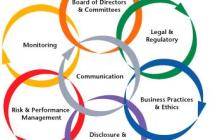
 Short answer – YES!
Not only the Corporate Governance but also the Organizational Structure need to be different in order to accommodate for the Triple Bottom Line accounting methods or in other words, for Sustainability. Period.
But first, let’s look at a statement that reflected the past companies behavior:
With business systems geared primarily towards growth and expansion, competition, maximizing consumption of non-essentials, maximizing returns to shareholders and directors etc., many organizations who report on effective corporate governance may be nothing more than a paradox. (Gray and Milne, 2002)
A decade after, lots has changed.
During my Green MBA study, my colleagues and I came across a number of examples and case studies that reflect a different view than the one stated above…and those case studies very much point towards a change in the existing Corporate Governance and organizational structure!
What’s happening?
Many companies are creating new roles and departments that never existed before:
- Sustainability Practice Leader
- Sustainability Champion
- CSO or Chief Sustainability Officer
- Green Leader
- Green Teams
These are the roles that we often find in a company serious on sustainability front. Their sole aim is to bring a change in the organization’s understanding of sustainability by giving mecahnisms and tools to for a transparent Triple Bottom Line framework.
While value of culture change is imperative in a company, if a company takes only a few strategic actions at strategic points, a lot of good can result to move towards it.
The challenge of sustainability, however is that, it is highly interconnected with all activities within a company. It must be integrated into the strategy and not viewed as a separate silo.
Also read How to Reinvent Capitalism via Creating Shared Value?
Change of structure at GAP
Sometime back I listened to a podcast by Dan Henkel, Sr. VP for Social Responsibility at Gap. He made several references that alluded to establishment of a solid corporate governance structure within Gap. Let’s see, very quickly how they went about doing it!
- Gap’s 1st CSR report came out in 2004.
- They then went about monitoring their activities within the supply chain which led to partnerships with various NGO’s and ethical and social groups in the following years.
- Only much later in 2006, Gap integrated the Environmental Affairs team into its Social Responsibility team – changes in the corporate governance took place.
(It took more than 2 years before a formal Environmental team was formed)
- In 2007, Gap received a lot of flak because of a child labor issue in India from one of their sub-contractors.
Gap could only handle the issue because of the strong ties with all those groups and strong reporting structure in place which they had developed over the past 3 years, after focusing on social responsibility (though it is only one element of TBL).
One of Gap’s factories is in country called Lusutu in Africa, where 1 in 3 garment workers are HIV positive. Henkel said that
if a company doesn’t do anything about HIV disease then they are missing the big picture
Calling for the CEO, stakeholders and policies
While it can be quite daunting to make structural changes in the governance for a big company, it is possible, if, CEO is also in the game.
It also means engaging deeply with the stakeholders. Sustainability is not a one-off project. Once companies come to an understanding that sustainability is not a cost to business but a way of doing it then it opens up a whole set of new attitudes across the functions.
Sure, it is much easier for new start ups to incorporate a structure of governance (not only inside the company but through the supply chain) in such a way so that it complements sustainability. But that’s not an excuse for big organizations.
So, we see that a good Corporate Governance not only includes following the legislations and laid out laws but also expanding an organization’s reach for the benefit of the society at large.
Without a dedicated sustainability team in place that calls for structural changes, corporate governance may just be a paradox.
Related reads
- 7 Mission Statements that inspire Sustainability (linkingsustainability.com)
- How to Reinvent Capitalism via Creating Shared Value?
- Tools for Triple Bottom Line Accounting
- Behind our sleek ipads and iphones – China & CSR
- One step for Chubu Electric, one giant leap for residents
- Restoring Trust in Corporate Governance: The Six Essential Tasks of Boards of Directors (bjconquest.com)
If you benefited from this post, why not email it to a friend or share it on Twitter or Facebook via the share button below. Thanks for taking the time!




 Linking Sustainability
Leave a reply to Don’t view 2% CSR spend as a spend – view it as a core business strategy | Linking Sustainability Blog Cancel reply