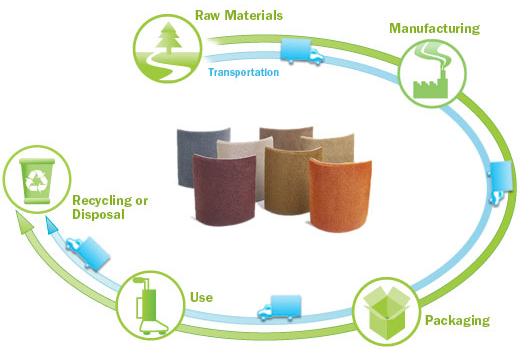
Life Cycle Assessment – from birth till death & closing the loop
What’s the common thread tying Levis, Timberland, Coke, Starbucks, and Patagonia – besides being some of my favorite brands, they all are leading field in the sustainability space! They are forcing other businesses to dive deep into the supply chains in their product’s life cycle to identify the hidden environmental impacts which otherwise would’ve been over-ridden by assumptions.

LCA is a tool that gives a close to accurate ecological footprint of a product’s journey from cradle to grave, taking a systems thinking approach in its entirety and not just some selected part in isolation.
Here’s what these iconic brands discovered
Levis figured out after doing a complete LCA map of their pair of 501 jeans that the maximum impact is in the consumer care, and not in the manufacturing processes, contrary to their assumption. 58% of its carbon footprint came from washing and drying jeans at home! However, the other big impact came at the other extreme – cotton growing, the most unsustainable form of agriculture.
(Cotton fields are dead zones – nothing grows and lives there except cotton, due to the humungous amounts of pesticides and toxics used in its plantation besides consuming loads of water)
Starbucks Coffee, after performing an LCA, found that 208 liters of water go into making one Grande sized Latte – 1/3rd of it used up in making milk and 2/3rd used up in coffee growing.
Patagonia’s LCA map revealed that a S-sized Patagonia cotton Tee uses more than 700 liters of water.
Coke’s one of the high areas of concern is water usage. 1 liter of Coke uses 1.9 liters of water.
Timberland’s carbon mapping showed that its maximum impact comes from the leather and PVC used in making shoes and the VOC (Volatile organic compound) based toxic adhesive used to glue the leather together.
Stonyfield Farm’s 42% emissions come from an unusual place – cows burps!
So, what’s the story behind? LCA locates the exact area of highest carbon impact, which enables designers to find long term sustainable solutions to these challenges.
Benefits of LCA
And that has led to Starbucks forming its CAFÉ code of conduct that works with farmers using the best coffee growing practices like the “Shade growing coffee’.

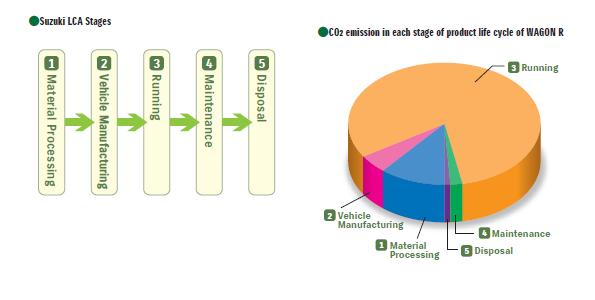
It has led Coke to innovate in water usage such as air- jet cleaning instead of water-jet cleaning, thus reducing it’s per liter Coke-water consumption. It has led Patagonia to move from industrial to organic cotton and led Levis to support sustainably grown cotton and repurpose the jean into housing insulation at its end-of-life. It has led Timberland to track down the farm where the animal grazed under humane conditions before ending up as a shoe. It also led to developing water based resin and an alternate to PVC, for its shoes.The most prevalent example of an LCA is the impact of a vehicle. 80% of the CO2 emissions come at the running stage of a car – when it is with the consumer.
Understanding LCA
In simple terms, LCA brings to fore the actual quantification of the resources that went into the factory at one end – energy, water, virgin materials and what came out of the factory at the other – emissions to land, water and air along with the packaged product.
LCA is about getting beyond to what you control. The thing to understand is that its not about maximizing one issue but about optimizing several simultaneously.
No single company controls more than 15% of the total impacts associated with their products – most of it is in either upstream or downstream phases. Using LCA, highly energy intensive processes and materials emerge giving companies the opportunity to design and innovate in ways that’ll reduce those impacts.
Related articles:
- Designer’s Toolkit: From Planned Obsolescence to Design for Environment (DfE) – I: Biomimicry
- Designer’s Toolkit: From Planned Obsolescence to Design for Environment (DfE) – I: C2C
- Designer’s Toolkit: From Planned Obsolescence to Design for Environment- III: Dematerialization
Images LCA of a Jean taken from http://www.levistrauss.com/sustainability/product/life-cycle-jean
LCA of WagonR taken from Suzuki Environmental Report 2009
Home page LCA image – Interface Carpets @ http://www.interfaceglobal.com/
If you benefited from this post, I’d be very grateful if you’d help it spread by emailing it to your friends or share via links below on Twitter or Facebook. Thank you!



 Linking Sustainability
Comments (moderated)