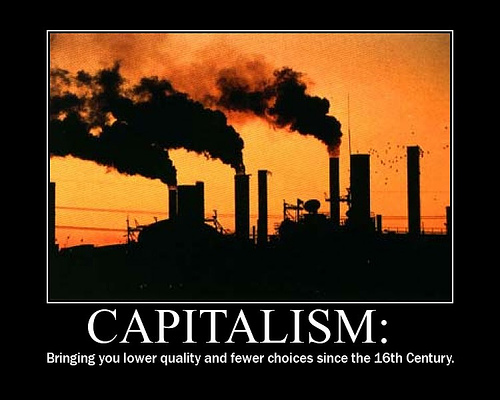
To answer this question, we need to first define what sustainable really means – in simple terms, to leave the planet and its natural resources in enough abundance so that the future generations are able to take care of themselves as we have been able to. But this again, begets another question as to how did we take care of ourselves – by the pollution economy. Will this same economy be sustainable? Will capitalism, the system that has worked so well for a couple of hundred of years be held in the same high regard?
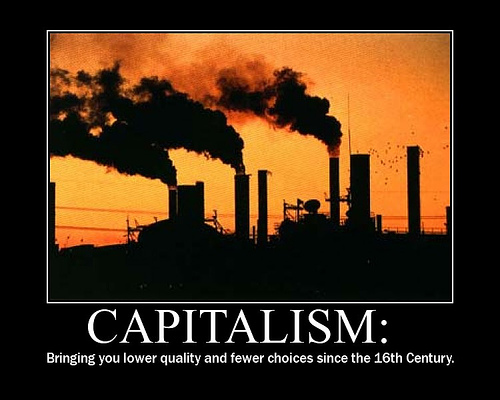
A deeper question – why do we want capitalism to be sustainable? Surely for all the benefits it provides – capitalism enables societies to prosper, improve safety and health, create employment so that more people can the have opportunities for education, knowledge, skills and can afford basic needs and luxuries to enjoy their lives.
Those we need – we can’t go back to stone age, but some of the values that we attached to it may no longer be desirable, say a hundred years from now. Already, we can see shifts occurring, not only in people’s minds, but also in business, though just fractionally. For example, values associated with owning a car- convenience, pride, image may just be invalid as we see in future more and more companies like “Zip car” in the US make owning a car useless.
Or perhaps, the resources that we have needed to build up our current economy, may no longer be needed to build the green economy. Search for new materials, a new ways of building things is driving innovation. But it will take time. And until that time, Triple Bottom Line (TBL) has to be a major initial approach.
Julie Richardson, in the book, “The Triple Bottomline”, so beautifully points out that – “until now, focus had been on measuring the quantities and reducing the complex systems to a single denominator – money. What we need now is the focus on enhancing qualities of sustainability, thus embracing the diversity and complexity. Until now, tools were adapted form accounting and economics, but now tools need to be adapted from holistic science of physics, evolutionary biology and ecology”.
 It is no wonder that, capitalism had its root in profit maximization because its basis was accounting and economics. What systemic approach will work that has its roots in holistic science, we don’t yet know. It’s not to say that socialism or dictatorship is better, just because we don’t know of any other way to sustain. When the focus, the basis changes from money to something else, we don’t know what kind of living system will there be for people and businesses.
Right now and for the coming decades, I believe the businesses will be in constant flux – changing and improving and greening themselves – and the triple bottom line is a good start.
Capitalism, as we know it, just cannot survive without a major move towards TBL, especially when China and India in the coming years want to live like the people in the developed world. If we can stop this 40% of humanity to come in to the middle class, sure at least for our purposes, capitalism is sustainable. But since, that is not a possibility, thus, TBL approach has to be made with much more intensity. Capitalism has to evolve through TBL.
And sure, more and more companies are genuinely making that push. Big businesses like Walmart, Nike, HP, Intel, Caterpillar, DuPont and many others have invested heavily in the TBL and have seen some initial benefits of the low hanging fruit. But most of the steps that have been taken would most likely would have been taken even if the TBL was not in question.
For example, making fuel efficient vehicles, reducing emissions, weight, noise, vibrations and foul odor are good for business anyhow. Prohibition of Freon, Lead, Mercury, Chromium and other toxic materials is a major move to environment friendliness.
Probably in the coming years, we will see a new definition of Capitalism emerge in the business world where TBL will be a given and new tools and reference points will be framed where money – the common denominator will be hard to put to work for issues like good stewardship, synergistic relationships, future growth of bio diversity and improved EHS. (environment, health and safety)
For more @ “The Triple Bottom Line: Does it all add up” by Adrian Henriques and Julie Richardson
http://www.zipcar.com/ : Car sharing, an alternative to car rental and car ownership
Related articles
- Education’s Triple Bottom Line (educationinnovation.typepad.com)
- How to Make Triple Bottom Line Decisions in Real Life (forbes.com)
- How to Reinvent Capitalism via Creating Shared Value?
- Value creation and good Corporate Governance



 Linking Sustainability
Leave a reply to nareshnayak Cancel reply